Taarab, also called tarabu or tarab, is Zanzibar's most popular music. Taarab is popularly known as Swahili wedding music, since taarab musicians and music are an essential part of these multi-day festivities. The east African coast has served as a center for trade with countries throughout the Middle East and Asia, and taarab music reflects many of the cultures which have passed through this region.
Through its years of development, taarabu has been an exceptionally inclusive art form, adapting and incorporating elements from Swahili, Arabic, Indian, Egyptian, and other cultures. This can be seen in the range of instruments used in taarab ensembles and orchestras which include Middle Eastern oud and dumbek, Indian tabla, western electric keyboards, and the Japanese taishokoto (described as a "banjo/typewriter-key hybrid"). Similarly, taarab rhythms reflect traditional ngoma dances like chakacha, Indian film scores, Cuban rumba, and various Zairean and East African dance music. Perhaps most importantly, taarab lyrics radiate with the allusive intricacies of Swahili poetry and showcase the beauty of this long, literary tradition.
The word taarab is of Arabic derivation and contains multi-layered meaning. Gilbert Rouget in Music and Trance explains taarab comes from "the verb tariba which means "'to be moved, agitated'...also signifies 'to excite, to want to move,' and hence 'to sing, to make music." Historically, taarab was first introduced to Zanzibar in 1870 by the Sultan Seyyid Barghash who brought a group of Egyptian musicians to his court. Barghash sent a Zanzibari musician, Ibrahim Muhammed, to study in Cairo and upon his return he formed the Zanzibar Taarab Orchestra. In 1905, Zanzibar's second music society, Ikwhani Safaa Musical Club, was established and continues to thrive today with around 35 active members. Ikhwani Safaa and Culture Musical Club (founded in 1958) remain the leading Zanzibar taarab orchestras.
Taarab's first modern superstar ascended in 1928 with the Swahili singer Siti bint Saad who appeared on hundreds of 78's, many of them recorded in India. Unlike the majority of taarab which was sung in Arabic, Saad sang in Swahili and presaged a change in the direction of the music. After her death in 1950, taarab lyrics became prominently Swahili, and more female singers appeared with formerly all-male musical clubs. Another dramatic turn occurred with the revolution of 1964's political push to de-arabacize the island and its cultural institutions. Some taarab clubs switched from Arabic to Swahili names, (although many have reverted back), and musical societies were fully opened to women members.
From zanzibar.net
One evening in Stone Town we went out to experience Zanzibar food, beer and of course the well known Tarab Music. It was a really lovely evening. we sat on the floor and on very short legged tables we sat and enjoyed the allroud wonderful and relaxed atmosphere. Then the musicians came in and suddenly it really felt that we were somewhere in a movie.
Showing posts with label Stone Town. Show all posts
Monday, March 26, 2012
Monday, February 13, 2012
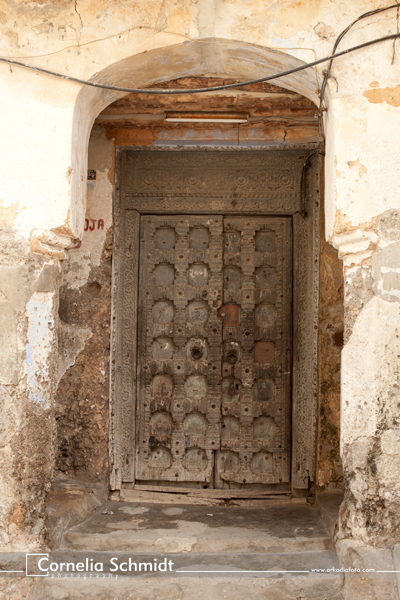
STONE TOWN AND ITS DOORS
Stone Town is well known for having a great amount of old doors in different styles. The indian ones with the spikes on it to prevent the elefants that never existed on Zanzibar to enter the houses. I hardly actually can see where an elefant could find place in the narrows streets. And then we have the Oman, arabic styled doorrs in wood as well. All of them well decorated and very very old.
It's a pleasure to stroll around the town and take pictures of them.
A shop that sells children dresses.
This last dorr is actually taken outside Stone Town in a village in the countryside.
Monday, January 30, 2012
RELIGION IN ZANZIBAR
Every school has it's uniform. So while we are in a muslim country even non-muslim girls have to wear the head cover that they then take off after school time.
The dominant religion in Zanzibar is the Islamic though you can find a few followers of Christianity and Hinduism. As a woman you should avoid having naked shoulders in respect for the local customs.
And topless bathing is absolutely not the right thing to do here.
There are several mosques in Stone Town, one on each corner it seems like. So, don't get surprised to be awakened by a chanting man screaming out lout 4 or 5a.m from your nearest mosquee. I will never really understand why they have to scream like this so you get a heart attach in the middle of your sleep. Another thing i don't understand and I have a hard time to accept is why woman or a non-muslim can't enter a mosquee. Why, what is there to hide that one can't get into? And what are they afraid about?
I know a lot of european people don't like to see woman all covered, but I like it. It's like a shower of happy coulours all over. Would't it be for the religions purposes I would see it on a fashion catwalk in Milano or New York. And then those woman, they walk so proudly, so high headed and really, haven't we had that too here in Europe non that long time ago? In Sicily you can still find it.
One night we were in the big park down at the ocean and there were plenty of black dressed woman, which weren't there the night before. Since I am pretty curious I couldn't hold on and went and asked the difference between the them and the other colourfulled women. One of the 3 girls I started to talk to could english and they had just arrived from Oman to spend one month of holidays. Their dressed were covered of stones that reflected so beautifully on the black fabric. So, there we go, I got the good explenation.
Subscribe to:
Posts (Atom)